S06 - E3 —> The Backlog Manager is Dead, Long Live the Product Manager

There has been, and continues to be, a lot of noise and proclamtions around Product Management, or more specifically, the Product Manager. And it tends to echo the same idea: the discipline is dead, the role is unrecognizable, or anyone who can’t [vibe code / ship with AI / prompt their way through a roadmap] is already obsolete.
In this edition, we’re going to challenge that sentiment head-on because the role they’re describing isn’t Product Management.
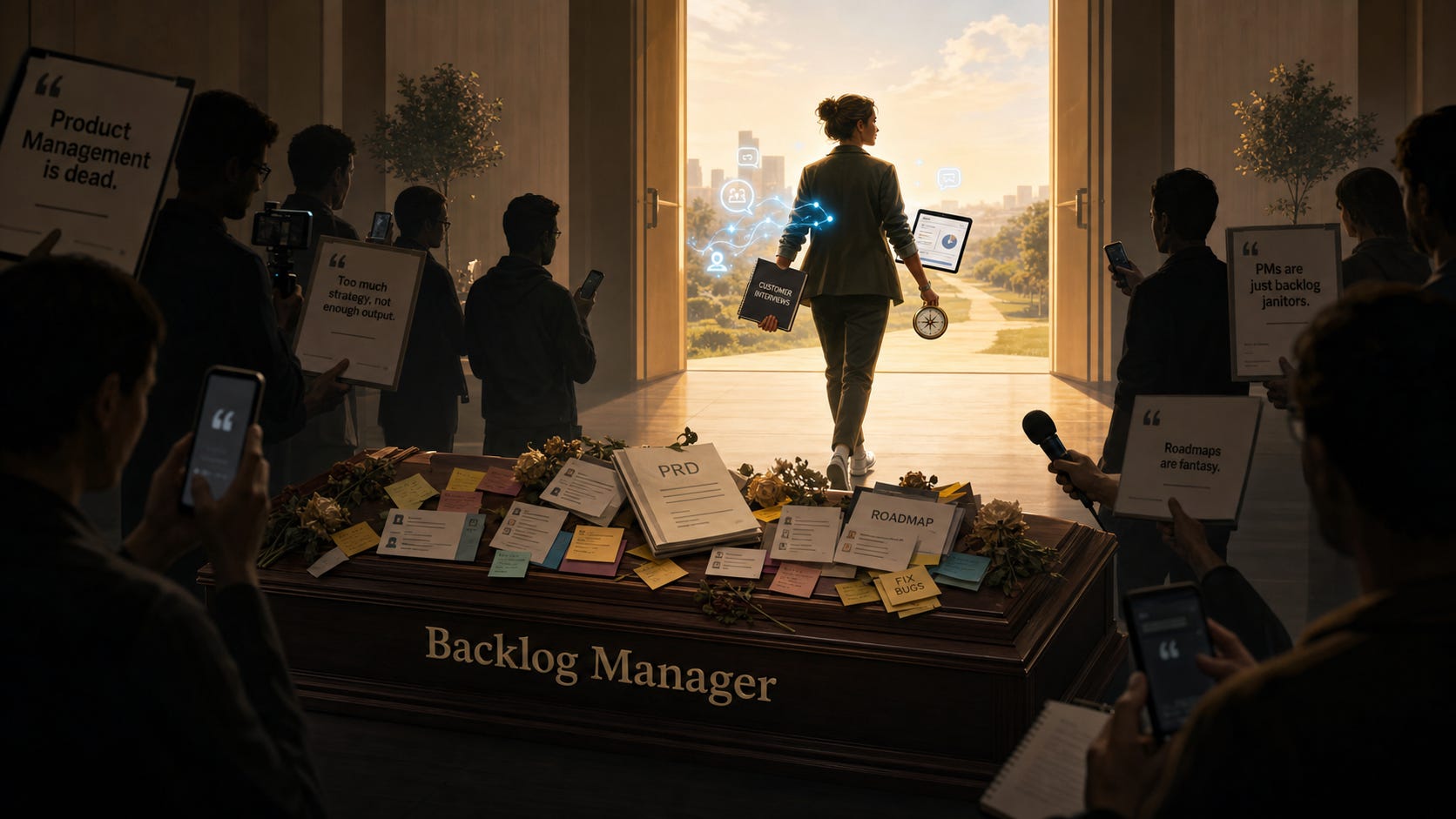
Q: Is Product Management or the Product Manager dead?
If you have been on Linkedin, listened to various podcast or even listened to the news, you cannot be faulted for thinking that indeed Product Management is dead, given what you and I have seen:
Keith Rabois, venture investor, predicting flatly that AI will eliminate the PM role entirely. Not reduce it, not reshape it, eliminate it. (Business Insider, April 2026 - https://www.businessinsider.com/keith-rabois-ai-impact-tech-jobs-product-manager-2026-4)
Nikhyl Singhal, former VP of Product at Meta and Google, arguing on Lenny’s Podcast that the “information mover” PM is already being replaced by “builders” – and that companies are quietly preparing to shed thousands of non-technical PM roles and rehire a smaller number of AI-fluent operators at triple the wages. (April 2026 -
)
The 2026 CPO Insights Report (Products That Count / Mighty Capital, survey of 1,500+ CPOs), which predicted that product managers will “disappear by 2030,” absorbed into a new hybrid “Product Builder” role that blends PM and engineering. (May 2026 - https://productsthatcount.org/CPO-research/)
And while I’ve read these pieces, listen to the Youtube videos, read the LinkedIn post and many more. Some of them made mew pause, and many of them made me genuinely quite uncomfortable, because the thing they were declaring dead was real, but they were not describing Product Management or at least good product management.
Myth and Reality or What are they actually describing
What they are describing is what Itamar Gilad, one of the sharper voices in product strategy, calls the Delivery PO. The PM whose job s translating orders into roadmap, roadmaps into PRDs, grooming backlogs, writing user stories, attending standups, and tracking velocity. The PM whose outcome is internal arbitration and orchestration, the PM whose week is 80% artifact production, 20% coordination and 0% understanding impact.
The delivery PO is many organizations (both Big Tech and more traditional organizations) plays an important role with the current construct. We’re not arguing otherwise, however that construct is being transformed in part by AI and thus the value they have been able to create is diminishing as the construct they operate in is transforming itself.
The tools will absorb the work, AI can produce a PRD, a user story, a backlog, and a sprint plan at a fraction of the time and cost. If that’s most of what you do, the math is no on your side. Product Management is not that
What Product Management
There was once a dream that was Rome. You could only whisper it. Anything more than a whisper and it would vanish
The best encapsulation of what Product Management is and what Product Managers should be doing is a quote from Shreyas Doshi (sorry Marty Cagan) that I keep coming back to ground me and my teams:
Do you actually know what your customers need, can you conceive real differentiation in the face of stiff competition, and can you build that differentiation creatively (and quickly)?
Read that again, and again. Write it down on a post-it and stick it on your screen. Three questions, every word is doing heavy lifting
The job is not “can you write a PRD?” The job is not “can you run a sprint?” The job is not “can you vibe code a prototype?” The job IS knowing the customer. Knowing the customer deeply enough to to have a genuine sense of what will work. The job IS knowing what is alternatives are out there so that you have a genuine sense of what is a differentiated solution and the job is being able to move fast enough to build it, iterate on it to get PMF before the window closes.
The Three Archetypes Everyone keeps talking about and the One worth Becoming
Alongside the “PM is dead” conversations, I’ve watched three new archetype emerge that everyone seems convinced are the answer. TL:DR each has some truth to it them, but none of them are the answer.
The AI PM: the specialist with deep knowledge of LLMs, RAG, inference, and model evaluation. This is a real role, and it’s worth having. But it’s a specialty, even if in vogue, like security PM or fintech PM not a universal future singularity. It’s also a category that will look like “internet PM from 1998” by 2030, briefly exciting, then absorbed as table stakes.
The Developer PM: the one who can vibe-code prototypes, use Claude Code and Cursor, ship early-stage features alongside engineers. This one is genuinely useful especially now, but the ability to create prototypes and more importantly to test assumptions and bets in an early pre-scale way should be part of every senior PM arsenal. Here Gilad’s read is right: it’s a capability, not a permanent identity. The tools are evolving fast enough that this will be tablestakes in 3 months if it’s not already.
The No-PM future: mostly noise. I file this right next to its short sighted kin, Founder Mode. This usually comes from founders who’ve never worked with a great PM, or from “AI killed X” content that’s more about attention than insight. Ignore it.
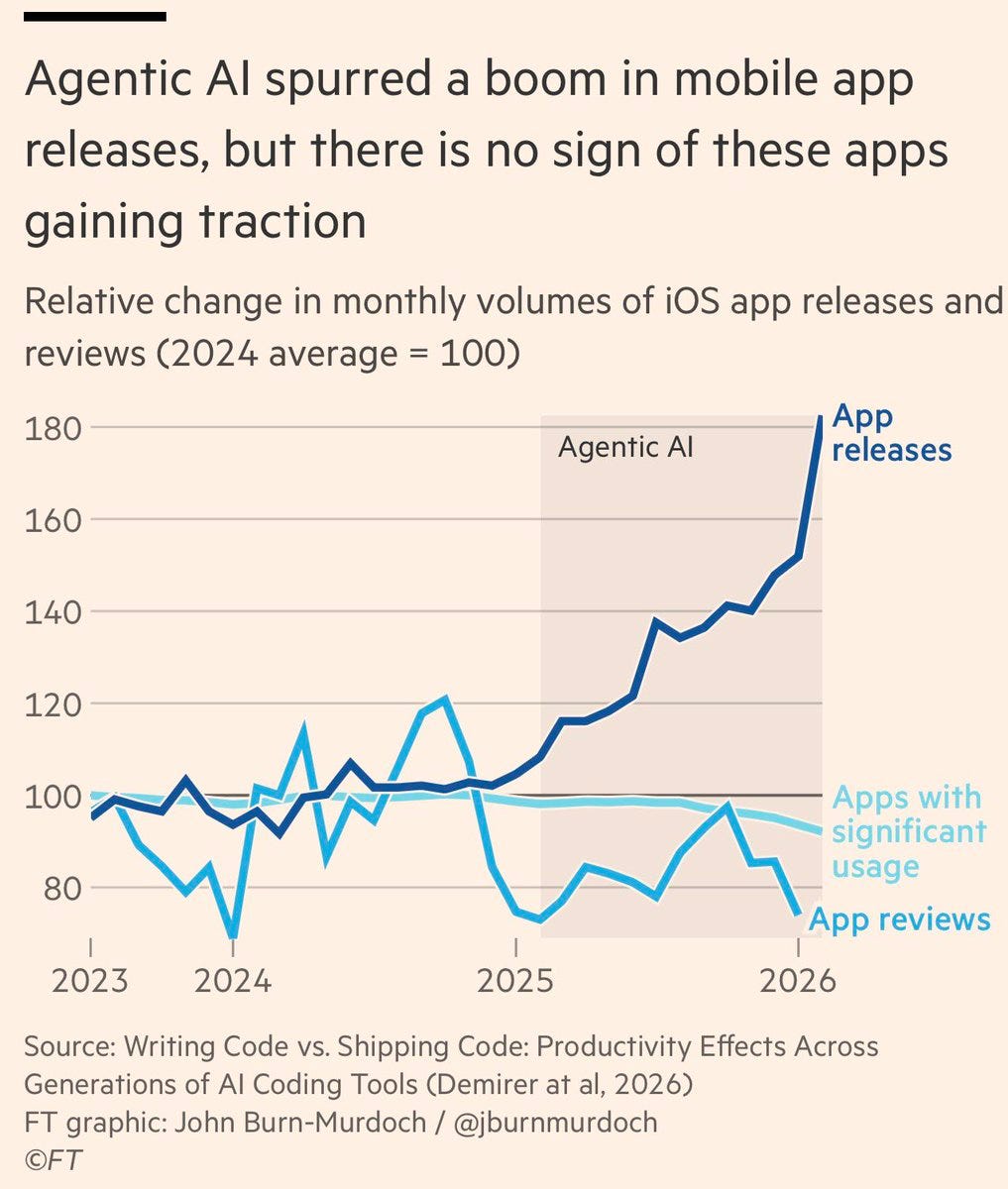
And even if we are in the era of the 3 archetypes above, the results, albeit early are not good. More slop available to customers who aren’t biting as the graph from Financial Times below shows
So which is the archetype worth becoming…
The archetype that Gilad names and that almost no one is talking about is the one I gravitate towards and find most useful, the AI-Empowered (the kids say AI-Pilled these days) Product Manager.
This is not a PM who can code or who uses AI tools, although those things in themselves are not disqualifiers, this is a PM who applies AI across the company’s full operating model, not just delivery, not just for writing, but how the company discovers problems, sets strategy, measures outcomes and builds. AI is transformational and the PM of tomorrow is one that transforms not just tasks but the way they work to embrace it. Many of these, problem discovery, goal-setting, customer understanding are functions that most companies underinvest because they are hard to measure, hard to credit and even harder to rush.
Most importantly, the PM of the future, regardless of what era they are going into, starts with the needs of the organization, the needs of the customer and see how the new tool (however transformational) allow them to help, to surface value.
The Individual Contributor View: Do and get good at the hard things
The Doshi test is worth repeating daily as a mantra and asking ourselves were we able to advanced today on any of the dimensions Doshi laid out.
Do you actually know what your customers need?
Can you conceive real differentiation in the face of stiff competition?
Can you build that differentiation creatively (and quickly)?
Three questions that should be daily discipline. You’re close to the customer signal by default, in the research sessions, reading the support tickets, watching the usability tests. The risk isn’t losing depth. It’s letting the delivery PO pattern creep in. Don’t let days fill back up with artifact production until the customer signal gets distant and the answers start coming from slides instead of real conversations.
The Executive View:
As a product leader the risks are multifold and different.
Risk #1 is enabling your Product Managers to be AI-Empowered. This means treating AI revolution very much like digital transformation, in other words an enterprise wide culture change, not a tools or technical initiative.
Risk #2 is hiring, or finding, the Product Manager version that has always been harder to find, measure and replace. The ones that actually seek to answer Doshi’s three questions, that knows the customer need, can see real differentiation in the face of stiff competition, and can build it creatively and quickly. The one that operates across the full machine, discovery, strategy, delivery, measurement with or without a slide deck to show for it.
That role is not dead. If anything, they’re finally getting the conditions they need to actually do the job.
What archetype are you betting on? I’d genuinely love to hear how you’re thinking about this. Drop it in the comments.
Before you go, please help us by completing the Three Actions:
1) Share this edition with others! It will help spread the word and get more upvotes. We like both of those things
2) “Star” this edition! Click the heart icon near the top or bottom of this edition 👇☝️
3) Reply! It only takes a few seconds, but the feedback is invaluable
Thanks for reading Product Hustle Stack Newsletter! Subscribe for free to receive new posts and support my work.